Think of a traditional phone number as a simple, hard-wired telephone on a desk. It does one thing: make and receive calls. A Twilio phone number is completely different. It’s a phone number that lives in the cloud as a piece of software, ready to be programmed to do almost anything you can imagine with voice, SMS, or MMS.
For any executive, it’s easy to overlook phone numbers as a simple operational line item. But that’s legacy thinking. A Twilio phone number is a programmable, strategic asset that changes how a business engages its customers. It’s the starting point for intelligent, automated conversations that scale with demand, directly affecting revenue and market position.
For a Chief Revenue Officer or VP of Sales, this technology is a direct path to accelerating sales cycles, driving operational efficiency, and creating a communications infrastructure that adapts in real time to business needs.
TL;DR
- A Twilio phone number is a cloud-based, programmable number you buy from Twilio to send and receive voice calls, SMS, and MMS through software and APIs instead of physical phone lines.
- You can get one in minutes from the Twilio Console or via the API, though some countries require address or business documents first.
- In the US, a local number costs $1.15 per month and a toll-free number $2.15 per month, plus pay-as-you-go usage for every call minute and message.
- Local, toll-free, and short code numbers each suit different jobs, with different costs and regulatory overhead.
- Businesses pair Twilio numbers with voice AI agents to qualify leads, book appointments, and lower the cost of each interaction.
How to Get a Twilio Phone Number
Getting a number takes minutes. Sign in to the Twilio Console, open Phone Numbers, then Buy a Number, search by country, area code, or capability (voice, SMS, MMS), and purchase. To provision at scale, use Twilio’s API to search and buy numbers programmatically, so a new campaign or support line can go live in an afternoon rather than weeks.
Some countries, for example Germany and France, require a local address or business documentation before a number is activated, which can add one to two weeks to the timeline.
Moving Beyond Traditional Telephony
Legacy phone systems are rigid, costly, and a bottleneck to innovation. Need a new number for a campaign? Prepare for manual procurement, hardware dependencies, and significant lead times. A Twilio number, being pure software, bypasses these constraints. A new number can be provisioned instantly via an API, configured for a specific business objective, and integrated directly into core systems such as Salesforce or HubSpot.
For a Director of Operations, this represents a shift from a fixed-cost model to a flexible, consumption-based service. A national retail launch could programmatically acquire 500 local numbers for a three-month campaign and release them afterward, paying only for the exact duration of use. This turns a capex problem into an opex advantage.
The Impact on Business Metrics
This is where the strategic value of a programmable number becomes clear. Sales and marketing leaders constantly battle low engagement rates, with outbound connect rates often sitting around 47% when using generic or toll-free numbers.
Equipping a sales development team with local Twilio numbers that match each prospect’s area code, a local presence strategy, can push answer rates above 90%. When you layer in a voice AI agent to handle that initial contact, lead qualification accuracy can reach the high 90s, ensuring high-cost human agents engage only with high-intent prospects. DialNexa’s voice AI report, based on more than one million AI-assisted business calls in India, found that brand-new calling numbers reached about 48% first-attempt pickup, and structured retries lifted cumulative connectivity above 70%.
The result is a measurable impact on business drivers. A financial services firm using this model saw average time-to-close for new investment products decrease by 22%. A SaaS company that automated lead qualification reduced its cost-per-qualified-lead from $150 to $45, a 70% saving. And since a lead contacted within 5 minutes is roughly 21 times more likely to qualify than one contacted after 30 minutes, the immediate response a programmable number enables is often the difference between a warm lead and a cold one.
Understanding Twilio Phone Number Capabilities
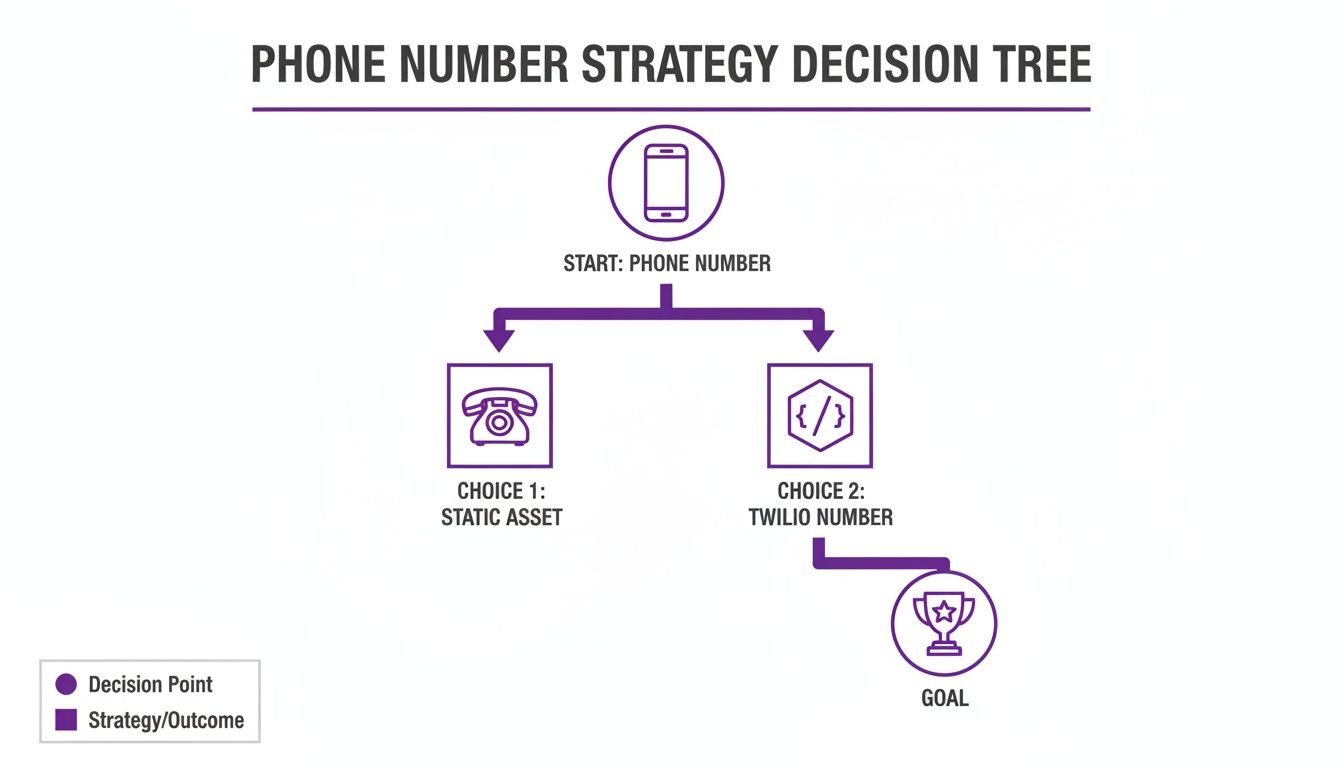
It’s easy to think of a phone number as just a string of digits, but a Twilio phone number is something else entirely. For any business leader, it’s best to see it as a programmable gateway for your entire customer communication setup.
Every Twilio number works as a toolkit. A single Twilio number can handle tasks that, in the past, would have required a patchwork of different systems and expensive contracts.
Core Communication Channels
The real power of a Twilio phone number is its versatility. One number can manage several different communication channels, letting you simplify your tech stack and cut down on complexity and costs.
Voice is the bedrock. You can build anything from a simple click-to-call button on your website to a sophisticated, multi-level IVR that routes callers automatically. It also opens the door to advanced features like predictive dialing, which can boost outbound agent talk time significantly.
SMS is well suited to sending high volumes of text-based messages. A logistics company, for instance, can send tens of thousands of delivery status updates in under an hour, often with open rates near 98%.
MMS lets you send images, GIFs, and even short videos. A real estate agent could send photos of a new listing directly to a potential buyer’s phone. Campaigns using MMS tend to see meaningfully higher opt-in and engagement rates than SMS alone.
Fax is no longer part of the Twilio toolkit. Twilio ended its Programmable Fax API on December 17, 2021, so teams in sectors like law, healthcare, and government that still rely on fax need a dedicated cloud fax provider alongside their Twilio numbers.
Strategic Number Types for Business Impact
Choosing a phone number is a strategic decision as much as an operational one. The same discipline applies to a virtual number strategy in India, where DID, toll-free, and the 140/160 numbering series carry their own compliance and routing implications.
A VP of Marketing who uses local numbers for a regional campaign can see call answer rates jump substantially. People recognise and trust a familiar area code, and that simple choice leads directly to more conversations and a better return on marketing spend. The table below compares the three main number types:
| Number Type | Primary Use Case | Relative Cost | Regulatory Overhead |
|---|---|---|---|
| Local | Regional presence for sales or support teams | Low | Moderate |
| Toll-Free | A single, professional national identity | Medium | Low |
| Short Code | High-volume, mass-texting campaigns | High | High |
In practice, most teams start with local numbers for outbound and support, add a toll-free number for national inbound, and consider short codes only once SMS volume justifies the higher cost and approval process.
Acquiring and Budgeting for Twilio Numbers
Getting a Twilio phone number is quick, but turning it into a smart investment requires financial foresight. Twilio primarily uses a pay-as-you-go model. Its published US voice pricing lists $1.15 per month for a local number and $2.15 for a toll-free number, with outbound calls at $0.0140 per minute and inbound calls to a local number at $0.0085 per minute.
For serious volume, committed-use discounts come into play. A campaign sending SMS alerts to 50,000 customers at Twilio’s base rate of $0.0083 per message segment costs around $415, plus carrier pass-through fees. Committing to higher monthly volumes unlocks tiered discounts on the per-message rate.
Practical Budgeting Examples
Two scenarios make the math concrete. First, an automated outreach initiative: a voice AI agent making 10,000 automated qualification calls, at $1.15 for the number and $0.0140 per minute, comes to about $281 in Twilio telephony charges for a 2-minute average call duration. The voice AI platform is billed separately on top of that, but the total is still well below the salary time a human team would spend making the same calls.
Second, high-volume SMS notifications: sending 100,000 order confirmation texts in a month, at $2.15 for a toll-free number plus $0.0083 per message, comes to about $832 before carrier fees, with volume discounts able to push the per-message cost down further.
Navigating Global Compliance
Every country has its own rulebook for provisioning numbers, and ignoring it can lead to sudden service disruptions. Germany requires a local address and proof of identity, a process that can take one to two weeks. France requires business registration documentation. Teams that operate in India should also compare the leading cloud telephony providers on local compliance and DLT support before choosing where to host their numbers.
Unlocking ROI with Strategic Use Cases
The theory behind programmable phone numbers is one thing, the bottom-line impact is another. A Twilio phone number becomes a tool that drives measurable returns, especially when paired with automation.
Real Estate: Driving Conversions
Real estate teams typically face a huge volume of online enquiries, many low-intent, with not nearly enough time to call them all. One firm deployed local Twilio numbers connected to a voice AI agent, and the AI handled the entire workflow of qualifying leads and scheduling site visits automatically. That single move pushed their lead-to-booking rate from around 2% to 8%, a fourfold improvement without hiring a single new person.
BFSI: Compliance and Cost Control
For BFSI leaders, compliance is a critical part of the business, and Know Your Customer verification is often slow, manual, and susceptible to error. Using compliant, recorded Twilio phone lines, a trading platform automated its KYC guidance calls, reducing manual processing time by 60% and creating a verifiable, time-stamped audit trail for every customer interaction.
Twilio has strong adoption in fast-growing markets, with India ranking as one of the largest sources of traffic to its website. Local Twilio numbers provide the low-latency, compliant connections that high-volume voice AI campaigns in EdTech and BFSI need to run reliably.
Expanding Automation Across Industries
The same pattern carries over to other sectors:
- EdTech: Twilio numbers acting as voice AI counsellors can field thousands of student questions about programmes and schedule follow-ups, meaningfully increasing qualified appointments for human counsellors.
- E-commerce: SMS-enabled Twilio numbers automating order confirmations, delivery updates, and return instructions can significantly reduce “where is my order” support tickets.
- SaaS: integrating Twilio with a CRM lets a voice AI agent instantly call a new sign-up, qualify interest, and book a demo, reducing average lead response time from hours to under 60 seconds.
A Twilio number provides the essential foundation for automation. When combined with an intelligent layer like a voice AI agent, it turns routine, repetitive tasks into scalable, cost-effective, revenue-generating workflows.
Integrating Twilio with Voice AI
A Twilio phone number on its own is a powerful communication tool. Paired with a voice AI platform, it becomes an engine for growth and efficiency. Twilio provides the global, reliable telephone network, the pipes and wires that make calls and messages possible, while the voice AI is the layer that brings intelligent, human-like conversation to life at a scale no human-only call centre could match.
Best Practices for a Flawless Integration
Be strategic about the numbers you choose. Use Twilio phone numbers with a clean history and high deliverability. For outbound campaigns, a portfolio of local numbers matching the recipient’s area code can meaningfully increase answer rates, since people are more likely to pick up a call from a number that looks familiar.
The real gains show up when the voice AI can access live data through an API. Connecting a CRM or other business systems lets the AI reference customer history and past purchases, pull up accurate order status instantly, and see a lead’s score and context for a more tailored conversation, all of which lifts satisfaction and conversion.
Most API integration trends in voice bots point the same way: the more live data an agent can reach during the call, the more useful each conversation becomes.
A Case Study in Scalability
Consider a real estate firm receiving thousands of online property enquiries every week. A human team would be swamped, leading to slow follow-ups and lost leads. By integrating a voice AI agent with a bank of local Twilio numbers, the firm automated the entire outreach process.
The AI agent, running on Twilio’s infrastructure, can handle thousands of calls at once without a dip in quality. It holds natural-sounding conversations, qualifies leads at high accuracy, and books property viewings directly into agents’ calendars, a level of throughput that is out of reach for a human-only team.
Twilio’s local numbers are available in more than 100 countries, which lets companies deploy voice AI that complies with local regulations and minimises latency, a critical factor for multi-minute conversations, whether it’s a healthcare platform booking patients or a SaaS team scheduling demos.
An Executive Action Plan for Programmable Voice
Turning this into a practical plan starts with an honest look at where you are today. The goal is to find where automation makes the biggest difference, prove the concept with early wins, and build from there, without ripping out the entire communications setup overnight.
Take Stock of Your Current Communications
Get operational leaders to benchmark the current setup against what’s realistically achievable. This should be driven by data, not intuition.
- Analyse call and SMS volumes: dig into inbound and outbound data to find the top reasons customers get in touch.
- Measure what matters: capture current call answer rates, average handle times, and first-contact resolution scores as a baseline.
- Find the low-hanging fruit: pinpoint repetitive, high-volume tasks that don’t require complex judgement, like scheduling, qualification, or reminders.
- Review existing costs: total up current telephony spend, including hardware, software licences, and staffing for routine interactions.
Define What Success Looks Like
A project without clear goals is just an experiment. Targets should be specific, measurable, and tied directly to business health.
- Cost-per-lead: track how much automation is saving on finding qualified leads.
- Customer satisfaction: measure the impact of instant, 24/7 service on how customers feel about the brand.
- Agent productivity: quantify how much more high-value work human agents complete once freed from routine calls.
- Lead qualification accuracy: benchmark AI performance against, or above, human team accuracy.
Conclusion
A Twilio phone number on its own is a flexible, programmable communications tool. Its real value shows up once it’s paired with automation, whether that’s SMS workflows, IVR, or a voice AI agent handling qualification and booking at scale.
At DialNexa, we build AI voice agents that sit on top of programmable telephony and handle qualification, booking, and support calls in English, Hindi, and other Indian languages, with CRM integration and human handover built in. Explore DialNexa to test it on your own call volume before committing to a longer build.
FAQs
1. How do I get a Twilio phone number?
Create a Twilio account, open the Twilio Console, go to Phone Numbers, then Buy a Number, and search by country, area code, or capability such as voice, SMS, or MMS. Most numbers are active within minutes. Developers can also search and buy numbers programmatically through Twilio’s API for bulk provisioning.
2. How much does a Twilio phone number cost?
Twilio uses pay-as-you-go pricing. In the US, a local number costs $1.15 per month and a toll-free number $2.15 per month. Usage is extra: about $0.0083 per SMS segment plus carrier fees, and $0.0140 per outbound voice minute. Volume discounts apply at scale, and prices vary by country.
3. Does Twilio give you a real, dedicated phone number?
Yes. A Twilio phone number is a real, dialable number that can send and receive live voice calls and text messages, not just a routing service. The difference from a traditional line is that it’s programmable through software and APIs, so you control how calls and messages are handled and automated.
4. Can I use a Twilio number for both calls and SMS?
Yes, as long as the number has both voice and SMS capabilities, which most local numbers do. A single Twilio number can handle inbound and outbound voice, SMS, and MMS together, letting you consolidate multiple communication channels onto one programmable number instead of running separate systems.
5. Can I use my own existing phone number with Twilio?
Yes, if it is eligible. You can port an existing business number into Twilio so it behaves like a programmable Twilio number, or use hosted SMS to text-enable a landline you already own. For most new campaigns, buying a fresh local number is faster and gives a cleaner sending reputation.
6. Can I connect a Twilio number to a voice AI agent?
Yes. Twilio numbers are commonly connected to voice AI platforms to automate outbound qualification and inbound support. The number provides the telephony layer, while the voice AI handles natural conversation, lead qualification, and appointment booking. Most platforms also manage routing, escalation, and CRM handoff automatically